

Reader Mailbag, Part 1: Young pitching, a Jordan Walker contract extension, Andre Pallante as a theoretical trade piece, MLB's blackout policy, the slumping Iván Herrera, and more
Readers have questions, writer has answers -- some of them possibly correct and coherent

Coming off a pair of stomach-turning one-run losses to the Diamondbacks (a blown 7-0 lead) and Angels (thus breaking a streak of 106 straight Halos losses in which they trailed going into the ninth inning), it’s time to talk it out.
You, gentle readers, responded to the recent call for mailbag questions with zeal and abundance, so I’ll be breaking up my replies into two posts. The first one is just below. Let’s go.
John writes:
Do you have any insight into the performance of the bigger arms on the farm? I know it’s a no-no to scout stat lines, but it seems that Liam Doyle, Jurrangelo Cintje, and Tanner Franklin have had bumpy years, to say nothing of Brandon Clarke only just now escaping the IL. Obviously, Cintje just got a call-up (so something was going right) and I know Doyle was working on his secondaries. Quinn Matthews has seemingly figured something out recently but only after a very messy first few months.
Basically, what’s real with these guys- are these good years masked by goofy minor league defense and hitter’s parks, or are these flags for future concern?
I’m not too worried. In Doyle’s case, learning to command his newly expanded repertoire is part of those struggles, and even for a highly drafted, major-conference college arm Double-A is an aggressive assignment for his first real professional season. On another level, a lot of Doyle’s top-line difficulties have come against left-handed batters, and given that Doyle is a lefty with wipeout stuff I can’t imagine there’s much to that. Framed another way, even with his walks, Doyle this season is striking out more than 30% of right-handed batters.
As for Cijntje, his recent promotion to Memphis suggests the Cardinals under Chaim Bloom and the revamped player-development program make decisions based on stuff traits, pitch shapes, the missing of bats, and so forth. I am admittedly still in “trust the process” mode with the Bloom regime, especially when it comes to developmental decisions in the minors, and being fine with their bumping up Cijntje to the highest rung of the system in the face of a 5.04 ERA (but better underlying performance) is evidence of that. There’s also occasionally something to be said for seeing whether an advancement in the face of seeming struggles unlocks something or provides a developing player with a needed reset. I am by no means attempting to draw comparisons with Cijntje in terms of ceiling or long-term value, but I immediately think of the Nationals calling up 19-year-old Bryce Harper despite a fairly disappointing stretch at Triple-A. You know how the rest went.
As for Clarke, well, please do appreciate:
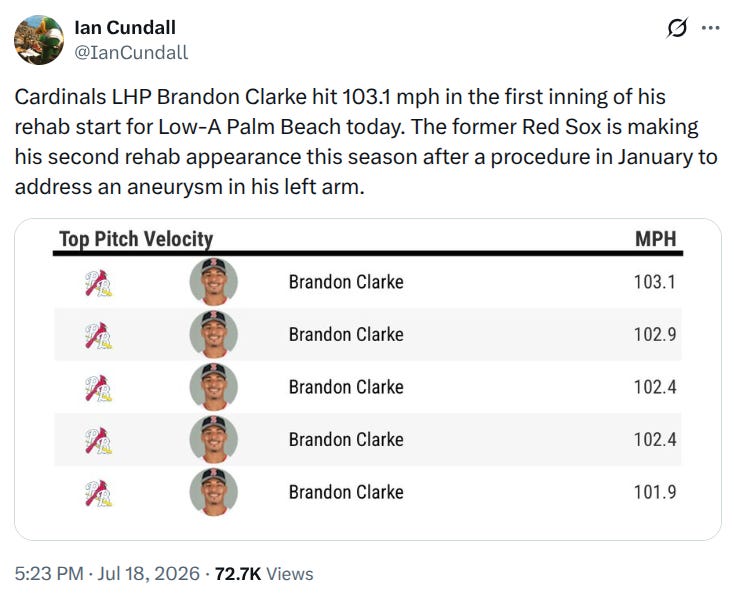
We may look back on Clarke as being the single best talent acquisition by Bloom during his earliest months on the job.
Franklin, meantime, is still very much a project, and extra patience is warranted. In college, he made just four starts compared to 61 relief appearances, and as an amateur he was frankly very bad at run prevention and control. In that context, he’s made good strides over 20 starts as a professional. We may not see Franklin in St. Louis before 2028, so there’s plenty of time for this ambitious conversion to take hold.
You’re of course correct to note Mathews’ recent performance spike, and my guess is said spike has made a trade of Dustin May even more likely. I bet we see Mathews as a member of the big-league rotation by the first week of August.
Also on the positive front, let’s note the emergence of Mason Molina, the longer-term promise of Yhoiker Fajardo, and the thus far encouraging return of Cooper Hjerpe. There’s also the recent selection of Tennessee right-hander Tegan Kuhns, whom some evaluators see as one of the most promising arms of the 2026 draft class.
Robert writes:
Do you think Ivan Herrera is a good 2nd place hitter?
I see him as more of an RBI guy, in the #4 or #5 slot.
Who would you use
I’m a bit concerned about Herrera right now, and even with the All-Star break just behind us I’m wondering if fatigue is an issue for him. He’s played in every game this season and logged more than 300 defensive innings at catcher. Stated another way, it’s July 21, and Herrera has played in almost as many games as he did all of last season. There’s a somewhat related issue of, in my opinion, not giving Jimmy Crooks enough of a consistent role since his recall. Really, though, I can’t shake the feeling that Herrera’s recent downturn at the plate (.302 wOBA and .308 xwOBA since June 1) is in part workload related. He also had a couple of pretty ugly and uncharacteristic chase swings against the Angels on Monday night. That’s an all-but-meaningless data point, but it just didn’t look like the Herrera we know. I’m also side-eyeing his loss of bat speed and uptick in ground-ball rate this season.
As to the meat of your question, I see the point in putting Herrera’s OBP in the two hole ahead of the power bats, but that thinking doesn’t really hold when Herrera’s been hitting – and thus reaching base – like he has for the past six or seven weeks. There’s also the outsized role that all those HBPs are playing in Herrera’s on-base numbers and how impossible it is to bank on those continuing to happen at such a clip. I’ve said before I like the idea of Jordan Walker’s power in the No. 2 spot behind JJ Wetherholt, and I also like the possibility of getting Walker an extra PA per game on occasion thanks to batting near the top. Herrera should be dropped in the order and slotted to keep the lefty-righty balance going against right-handed starters, and he should also probably catch less often than he is presently.
Jay writes:
I hear a lot of names being discussed as potential trade pieces as the deadline approaches but I have not heard Andre Pallante’s name. If there was ever a “sell high” opportunity with a Cardinals player, I would think this is it. His chase, whiff, and K percentage are all in the bottom 15 percentile. He has two years of control left, maybe Bloom can grab a younger arm with more control from a contender?
That’s possible, as Pallante this season boasts a sub-4.00 FIP and a career-best K/BB ratio. At the same time, he’s added an offspeed offering, stepped up the velocity and IVB of his fastball, and otherwise tweaked his pitch mix. The results have been good in some ways, but as you note he’s still near basement-level when it comes to missing bats and getting chase. You have more latitude on that front when you get ground balls like Pallanta does, but he’s still strikeout-starved by any standard. All that said, the same improved traits that make him appealing to other teams, at least theoretically, also make him valuable to the Cardinals. Are the Cards really in a position to trade away reasonably promising rotation arms with multiple years of control remaining? For the rest of this season, could they cover the innings void if May and another current rotation member are traded? Maybe Hunter Dobbins and Mathews can indeed do that, but there’s risk in dealing away 40% of your rotation with some two months of regular season remaining.
For these reasons, I lean toward thinking Pallante isn’t likely to be dealt before the Aug. 3 trade deadline. Once they have a better roadmap of the 2027 rotation, that may well change, meaning that an offseason trade of someone like Pallante – or, one supposes, Matthew Liberatore or Kyle Leahy – may be more likely than a deadline deal. I suspect they’re still evaluating those names as long-term fixtures in the rotation and whose timelines best align with the next wave of starters coming up through the system.
Jonathan writes:
Please “steelman” the case that a Jordan Walker extension is a bad idea. I have some initial thoughts, such as long, complicated swing, large body could age poorly, low defensive floor.
This is a challenge for me because I strongly advocate signing Walker to an extension that buys out multiple free agent years, even if the cost stretches deep into the $200 millions. The main things I’d point to if making such a case (to which I do not subscribe) are the lack of track record at the highest level (more than 1,000 plate appearances of deep struggles prior to this season versus a mere 414 PAs of excellence in 2026) and the still high to relatively high levels of whiff, chase, and strikeouts. That’s really it. I don’t worry so much about how he’ll age, in part because of his excellent footspeed and strong quick-twitch traits at the plate. It’s possible he’s a DH or first baseman before he turns 30, but the bat should play anywhere.
In other words, sign the man.
Mike writes:
What is the reasoning behind blackouts and will they ever go away?
MLB and the union both sound committed to restructuring local media rights in the next collective bargaining agreement so that those blackouts go away at least by 2028, when so much of the league’s suite of broadcast deals is up for bid again. Right now, though, it’s intact, and it’s a dogged vestige of the cable-television era/asset bubble.
By way of example, I live in Chicago, and I watch Cardinals games via MLB.tv, the league’s out-of-market streaming package. However, when the Cardinals are playing a team from the broadcast territory I live in – i.e., the Cubs or White Sox – I can’t watch those games unless I have a cable or satellite package that has a carriage agreement with those teams or I subscribe to those teams’ in-market platforms. The whole idea is to provide me with incentive to pay to watch the games of my in-market teams. If I were a devoted fan of the Cubs or White Sox, I would do that, just as I would subscribe to the Cardinals’ direct-to-consumer service if I lived in St. Louis and environs. As a Cardinals fan living in Chicago, though, I’m not paying extra to watch even a substantial number of Cards-Cubs games (shout-out: Reddit workarounds).
At least I don’t live in Iowa City (blacked out from Cardinals, Cubs, White Sox, Royals, Brewers, and Twins games) or Las Vegas (blacked out from Dodgers, A’s, Giants, Diamondbacks, Padres, and Angels games). So, yeah, this system really needs to go away.
Jay writes:
Why is the media so hesitant to embrace what McGreevy is doing? He has 13 quality starts this season, 4 more than May. For context, Sonny Gray had 12 as a Cardinal last summer. McGreevy has only surrendered 4 or more earned runs 3 times this year. May and Pallante have both done that 5 times. In a season of a lot of highs and lows by Cardinals starters, McGreevy has been as steady as they come.
I can’t speak to any sort of broad-based media perception of McGreevy, other than to say I haven’t heard anything negative about him. He’s been a bedrock in the rotation this season, no doubt about that. He boasts a sub-3.00 ERA at this writing, and he’s twirled a quality start in more than two-thirds of his trips to the bump. He can continue being effective thanks to his command of a deep repertoire and ground-ball tendencies in front of perhaps the league’s best double play combo. However, the strikeout rate is really bad, and it’s going to be hard for him to continue running a BABIP of .255, as he’s done this season. I think he’s fixture long-term at the middle to back of the rotation – there’s a lot of value in that – but absent a big leap forward in swing and miss I don’t see McGreevy as an emerging ace. Ideally, he won’t need to be.
OK, that’ll do it for this round. I’ll be back soon with the rest of your mailbag contributions.