

Reader Mailbag, Part 2: The prospect of contention now and in 2027, the future rotation, and Masyn Winn's outlook as a hitter
Readers have questions, writer has answers -- some of them possibly correct and coherent

This week, we’ve undertaken the process of moving our son into college for his freshman year, so my plans to roll out Part 2 of this mailbag didn’t go as planned. That is, I hoped to get it out sooner. Better late than forgotten altogether, though.
Anyhow, Part 1 was semi-recently, and now here’s the breathlessly awaited Part 2 …
Bob writes:
We have watched this team all season and seen them go from being nine games over five hundred and in the playoffs to being two games under and out of the playoff picture. Can you explain what happened? Do you believe this roster is capable, given the trades, of turning this around again and making a run at the playoffs? And if not, can this roster compete next year? What needs to improve?
These are just the tides normal to a marathon-length season such as baseball’s. Part of it, also, was probably some regression that was in order after the Cardinals outplayed their run differential for much of the early weeks and months of the season. In other words, they gradually found what was likely their truer level of performance all along.
That said, yes, a playoff run this season is entirely possible, although that says quite a bit about the low bar set by the third NL wild card spot. Right now, the Cardinals are three games out of playoff position. While things can still change – the Nationals, Reds, and Pirates could easily re-enter the fray – right now the Cards are one of five teams jostling for the final two spots in the NL bracket. Here it is in state-of-the-art screenshot form:
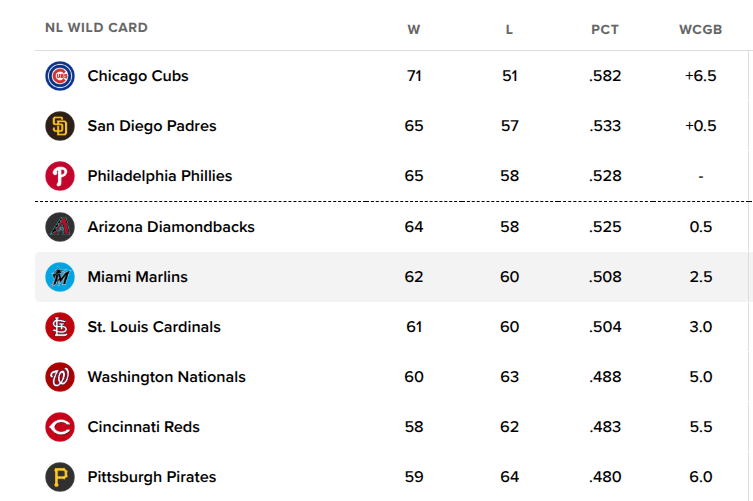
Looking ahead, the Phillies and Marlins have tougher schedules the rest of the way than do the Cardinals, Pads, and D-backs, who are all bunched together in remaining opponents’ average winning percentage. There’s also the matter of tiebreakers. Thanks to the bloated playoff schedule, MLB no longer makes room for tiebreaker games. Instead, head-to-head record, or the outcome of the regular season series between the two teams of note, is the first tiebreaker when it comes to solving ties for division titles, wild card spots, and seeding. On that front …
The Diamondbacks hold the tiebreaker over the Cardinals.
The Cardinals hold the tiebreaker over the Padres.
The Cardinals lead the season series against the Phillies 2-1 with three more to play.
The Marlins hold the tiebreaker over the Cardinals.
And should it become relevant:
The Cardinals lead the season series against the Nationals 2-1 with three more to play.
The Cardinals lead the season series against the Reds 5-3 with five more to play.
The Cardinals lead the season series against the Pirates 5-2 with six more to play.
Effectively, the Cardinals are 3 ½ games behind Arizona because they’d lose the tiebreaker in the event of a tie in the standings.
Elsewhere, some possible roster developments give reason for additional hope. Nathan Church and Everson Pereira, recently claimed off waivers from the White Sox, have the makings of a solid center field platoon, at least for the near-term. Power-hitting prospect Joshua Báez has made progress in improving his contact and chase rates in recent weeks and may be days away from a call-up. That’s because in just another day he’ll be able to retain his rookie status going into 2026 and thus make the Cardinals eligible for a prospect promotion incentive draft pick (which JJ Wetherholt will net them this season, provided he wins NL Rookie of the Year honors). Báez is probably ticketed for left field. Cardinals left fielders this season have combined to hit .237/.298/.380, so it’s entirely possible that Báez will improve upon that slash line.
As for 2027, yes, I again think it’s quite possible they’ll contend for a postseason spot. Again, it’s typically not going to be that hard given that six teams in each league make the playoffs, and this next CBA, which theoretically will be in effect for the 2027 season, may unfortunately swell the playoffs again.
Broadly, ahead of 2027 the Cardinals need to decide what their rotation will look like (will Matthew Liberatore be part of it?), what the bullpen will look like, and what center field and third base will look like. Those seem like the leading roster issues looking (far) ahead to next season. My personal expectation is wild card contention in 2027 and division title contention in 2028. We’ll see if I’m getting over my skis a bit with those expectations.
Bill writes:
If everyone currently in the organization hits their ceiling, is the ideal 2029 rotation Cijtnje, Matthews, Doyle, Roby and Clarke? Not necessarily in that order. Or is that underselling Tanner Franklin and others?
If everyone in the organization hits their ceiling, man, the 100-win seasons will flow like intrepid rivers. They won’t all hit their ceiling, of course, but I appreciate the rosy thought experiment. This is subject to change, but my one through five based on ceiling – or my estimations of ceiling, to be exact – would probably run like this …
Brandon Clarke, LHP
Jurrangelo Cijntje, RHP
Liam Doyle, LHP
Tegan Kuhns, RHP
Tanner Franklin, RHP
The decisions get tough after the top three, which speaks to how much depth and upside the Cardinals have right now on the young pitching front. I can see cases for Quinn Mathews, Tekoah Roby, Cooper Hjerpe, Yhoiker Fajardo, Mason Molina, Daniel Eagen, and even Ixan Henderson. No doubt, others besides Kuhns from this most recent draft class will emerge. This is to say nothing of the current rotation members who might be long-term fixtures like Michael McGreevy, Kyle Leahy, and Hunter Dobbins, and don’t forget about Richard Fitts. It’s going to be fascinating to see how Chaim Bloom and company sort out any logjams, whether via trades or shifts to relief roles. Speaking of the latter, all that depth has the cascading effect of making an effective, largely homegrown bullpen all the more likely.
Good “problem” to have, as the saying goes.
Bret writes:
I’m a bit concerned about Masyn Winn’s offense. His production has regressed every season. From the naked eye I have no idea what his approach is. His back foot is all over the place. He doesn’t appear to have a plan. Do you have concern or insight into his offense?
This is definitely a fair concern. Winn as a big leaguer has seen his full-season OPS+ decline from 104 in 2024 to 91 last season to 84 thus far in 2026. At the same time, his full-season xwOBA has meandered from .296 to .286 last year to .303 this year. He’s actually gotten a bit unlucky at the plate this season, as his wOBA has undershot his xwOBA. For context, the average MLB shortstop this season has an xwOBA of .308, so Winn at an underlying level has been average-ish at the plate by positional standards. Throw in the fact that he’s one of the very best defensive shortstops in baseball and you have a player who’s worthwhile even when he’s not hitting. Winn’s fielding, as long as it stays at its current level, is going to provide him with a 2.0–ish WAR base, and that has a lot of value.
All that said, it’s reasonable to wonder whether Winn has a higher gear at the plate. He’s been much more assured and productive with the bat over the last week or so, but we of course don’t want to read much into such a microscopic sample. On the other hand, there’s this recent bit of reporting from Benjamin Hochman at the Post-Dispatch (subscription required and highly recommended):
“Winn said he was in the batting cages along with close friend Jordan Walker and Casey Chenoweth, one of the Cards’ assistant hitting coaches.
“‘Casey was actually looking at some stuff J-Walk needed to work on, and it actually kind of inadvertently helped me. So that’s been, that’s been huge working on that. Just kind of driving the back elbow. Me and Walk have kind of been getting around the ball with our back elbow, so just trying to be more direct, I think, has been helping me a lot. …
“‘Everybody wants to pull the baseball, but you know, there’s a certain way to do it, and you know, the way I’ve been trying to do it this year hasn’t worked. And really just you know dropping that elbow in a slot and going directly to the ball has been good for me recently. It’s helped me go backside, but at the same time, I’m starting to pull some balls the right way. I think it’s a more direct path, quicker swing.’”
Nothing’s going to change the nature of the sample size, but at least there’s a mechanical change that coincided with the increased production. That increases the chances of it being more than just baseball noise.
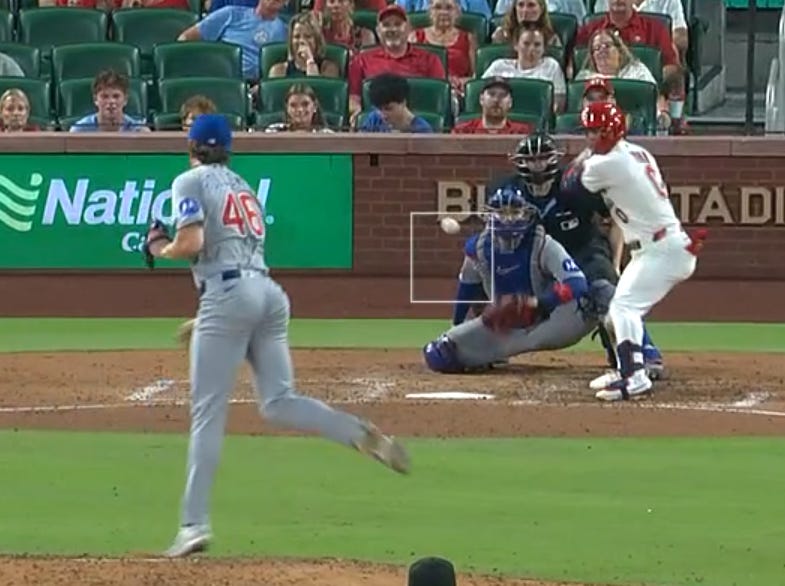
That “quicker swing” part is important, as focusing on that back elbow slot may be helping Winn’s timing and sequencing at the plate. Here’s Winn at the moment of front heel strike (i.e., when his heel touches the ground after his leg lift) an instant before singling off a sinker from Gavin Hollowell back on June 27:
Now here’s Winn, after making the tweaks detailed above, at the instant of front-heel strike and about to single off an Alex McFarlane sinker on Tuesday:
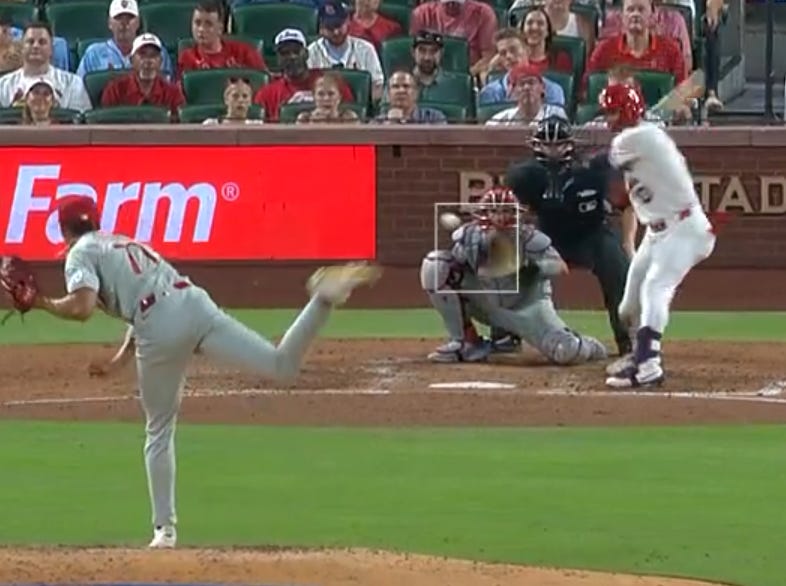
He’s timed up much better in the more recent image with hip rotation already underway and the front knee locking out and forming a block and in a much-better position to do batted-ball damage. McFarlane’s sinker, by the way, came in at 100.2 mph versus a 94.6 mph velo on Hollowell’s sinker. So the differences you see above aren’t the result of a more hitter/timing-friendly pitch velocity.
No, I’m not declaring Winn to be “fixed” or suddenly on a higher plane as a hitter forevermore, but the uptick and the swing adjustments should at least have our attention for a while. Maybe there’s something to it.
That’ll do it for this time. Back soon with more.